
Last Updated: October 29, 2026
Quick Summary
After a criminal arrest, officers record your booking information and fingerprints, then you typically appear in court for an arraignment, where you are told the charges and asked to enter a plea. Your most important right is to remain silent and request an attorney before answering questions. Release may come through a citation, bail, or conditional release, depending on the charge and your circumstances.
- Anything you say to officers, even casually in a patrol car, can become evidence.
- Booking records your name, date of birth, charges, photograph and fingerprints, and creates an official record.
- The arraignment is the first formal court hearing, where bail and release conditions are often decided.
- Missing a court date can lead to a warrant for your arrest, so confirm the time and location in writing.
- Two deadlines people often miss are license-board reporting windows and the first court date.
Table of Contents
- The Arrest Process: What Officers Do and What You Are Entitled To
- What Happens After Booking: Processing, Records and Fingerprints
- What Is an Arraignment and Why the First Court Hearing Matters
- Bail and Release After Arrest: How Bond Decisions Are Made
- Criminal Charges, Probable Cause and How Your Case Moves Forward
- Digital Evidence, Your Phone and Privacy After an Arrest
- What to Do After Being Arrested: Protecting Your Job, Licenses and Next Steps
- Frequently Asked Questions
If you have just been arrested in Los Angeles County, the next few hours can feel chaotic, and what you say and do in that window matters. Our step-by-step guide to what to do after being arrested covers your immediate next actions, including contacting an attorney and options for release. This guide walks you through what happens after a criminal arrest, step by step, so you know what to expect. Criminal arrest processes follow a general sequence in most jurisdictions, and the stages covered here are the ones most people encounter. (Source: the Fifth Amendment of the U.S. Constitution)
The Arrest Process: What Officers Do and What You Are Entitled To
An arrest is the act of taking a person into custody because an officer has reason to believe a crime was committed.
The most important of these is the right to remain silent under the Fifth Amendment. You are not required to answer questions about where you were, what happened, or who else was involved.
A practical point many people miss: anything you say to officers, including casual remarks in a patrol car, can become evidence. Stay calm, be polite, and keep your statements to a minimum until you have counsel.
What Happens After Booking: Processing, Records and Fingerprints
Booking is the administrative process that follows arrest. Officers typically record your name, date of birth, the charges, and any identifying details, then take your photograph and fingerprints. Your personal property is inventoried and stored, and you may be searched.
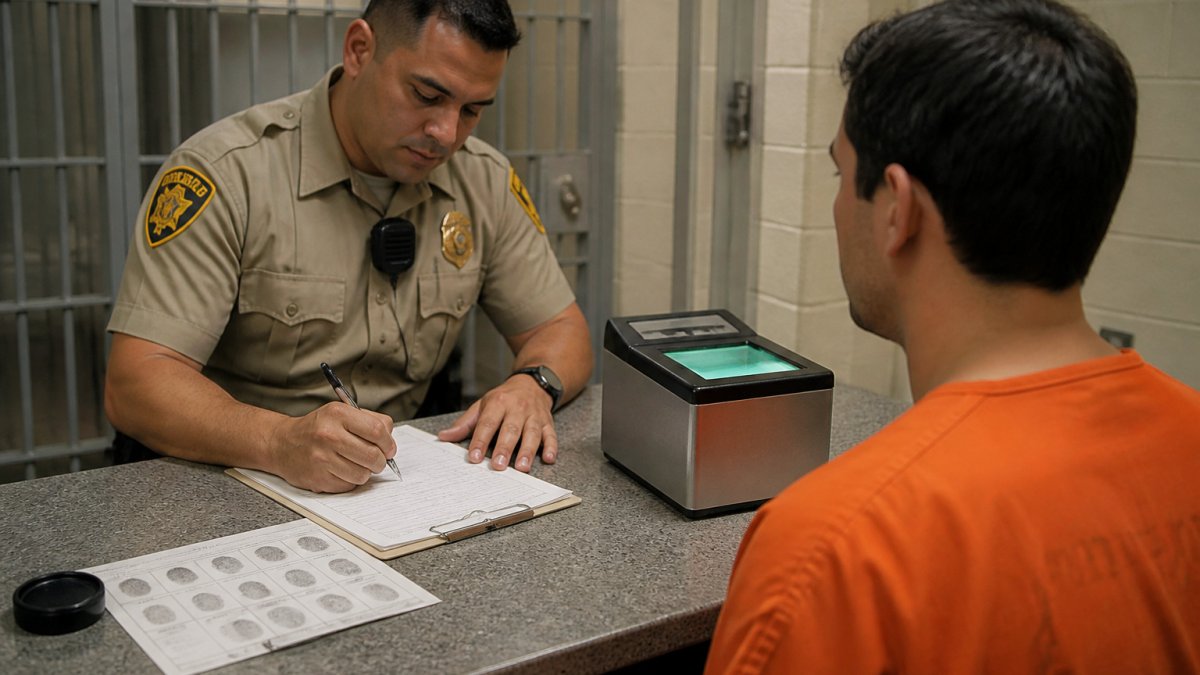
Booking creates an official record, and that record often becomes the starting point for your criminal history. Accurate information matters, so if you notice an error in your booking paperwork, raise it with your attorney as soon as possible. Depending on the charge and your circumstances, you may be released on a citation, held until bail is posted, or held until your first court appearance.
What Is an Arraignment and Why the First Court Hearing Matters
An arraignment is the first formal court hearing in a criminal case. At this stage, the court informs you of the charges, confirms your identity, and asks you to enter a plea, typically not guilty at this early point. The judge also addresses custody status and whether you will be released pending trial.
This hearing is far more significant than it may appear. If you have already missed one, see what to do now after missing a court date.
Bail and Release After Arrest: How Bond Decisions Are Made
Bail is the amount of money or property a court requires to release you from custody while your case is pending, with the goal of ensuring you return to court.
How the amount is set. Many jurisdictions publish a bail schedule that assigns a preset dollar amount to each charge. Our guide shows how to post bail in California, step by step.
The forms of release you may encounter:
- Release on your own recognizance (OR): You sign a promise to appear and are released without paying money. Common for low-level charges and defendants with strong community ties.
- Secured bond: You or a family member posts the full bail amount with the court. Depending on the terms of the bond and the court’s rules, the money may be refunded at the end of the case if you appear as required.
- Surety bond (bail bondsman): A licensed bail bond company posts the full amount on your behalf. A bail bond company typically charges a non-refundable premium, and may require collateral. Premium rates are set by state and county rules, so confirm the current figures with the bondsman and official sources. The bondsman may also require check-ins and can revoke the bond if you miss a condition.
- Unsecured bond: You promise to pay the bail amount if you fail to appear, but you do not post money up front.
- Conditional release: The court releases you with conditions such as regular check-ins with a pretrial services officer, travel restrictions, electronic monitoring (ankle monitor), no-contact orders with alleged victims, or substance-abuse testing.
Pretrial services, the piece most guides skip. Some courts use pretrial services officers, who may interview you after arrest and prepare a report for the judge. This is not probation.
Conditions of release are enforceable. Every condition, check-ins, curfew, travel limits, no-contact orders, is a court order.
If you used a bail bondsman, missing a court date can trigger a bounty hunter recovery, forfeiture of collateral, and a new criminal charge. Notify your bondsman and your attorney immediately if any circumstance prevents you from appearing.
Pretrial release and bail resources
The article lays out the main forms of release a defendant may encounter, and what each one generally involves.
| Form of release | How it works | Key point |
|---|---|---|
| Release on own recognizance (OR) | Sign a promise to appear; no money paid | Common for low-level charges and strong community ties |
| Secured bond | Full bail amount posted with the court | May be refunded if you appear as required |
| Surety bond (bail bondsman) | Licensed company posts the full amount | Non-refundable premium; may require collateral |
| Unsecured bond | Promise to pay if you fail to appear | No money posted up front |
| Conditional release | Court sets conditions such as check-ins or monitoring | Violations can lead to revocation and new charges |
Criminal Charges, Probable Cause and How Your Case Moves Forward
After arrest, prosecutors decide which charges to file, if any. If you are facing a misdemeanor, this legal guide to arraignment, plea options and protecting your future explains the key steps to take. Charges are generally classified as misdemeanors or felonies, and the classification affects possible penalties, court procedures, and long-term consequences.
Probable cause applies at several points in a case. It is the standard that justified the original arrest and is also the standard used to determine whether charges move forward. Your attorney can examine police reports, witness statements, and evidence to challenge weak or improper claims.
Digital Evidence, Your Phone and Privacy After an Arrest
Modern arrests often involve digital evidence. Officers may want to examine your phone, computer, social media accounts, or location data. Your rights here are important: you generally do not have to unlock your phone or provide passcodes, and you can ask for your attorney before consenting to any search.
Do not delete messages, posts, or accounts, since destroying evidence can create new criminal exposure. Instead, tell your attorney what digital material might be relevant so they can advise on preservation and any challenges to how it was obtained.
What to Do After Being Arrested: Protecting Your Job, Licenses and Next Steps
Start with the immediate steps: request an attorney, avoid discussing the case with anyone other than your lawyer, and confirm your court dates in writing. For guidance on protecting a professional license after a criminal charge, review your licensing board’s reporting rules early.
Professional licenses and self-reporting. Many licensing boards require licensees to report an arrest or charge within a set period. Deadlines vary by board, so check your board’s current rules.
Background checks and timing. A pending charge may appear on a background check even before any conviction, depending on the reporting agency and the state.
Housing, immigration, and benefits. A criminal charge can affect rental applications, immigration status, and some public benefits.
Digital housekeeping. Do not delete messages, posts, or accounts.
Two deadlines people often miss are license-board reporting windows and the first court date. Confirm your court date in writing as soon as you can.
Naderi Law Office, Inc. offers aggressive criminal defense representation for individuals facing charges in Los Angeles County, and offers a free case evaluation. Our attorneys are available 24/7. Contact us today to discuss your situation and the defense options available to you.
Frequently Asked Questions
What happens during the arrest process?
During an arrest, officers must have probable cause or a warrant, and they will typically identify themselves, tell you that you are under arrest, search you for weapons, and take you into custody. You have the right to remain silent under the Fifth Amendment, and you should clearly state that you want a lawyer. Anything you say can be used as evidence, so keep your statements brief. Stay calm, do not resist, and remember details such as officer names and badge numbers for later use by your attorney.
What happens after someone is booked into jail?
After booking, the jail records your personal information, takes fingerprints and a photograph, runs a background check, and inventories your belongings. You may be placed in a holding cell until you are either released or brought before a judge. Booking is an administrative step, not a court decision, so the charges are not yet resolved. Contact a criminal defense attorney as soon as possible, since timing matters for bail and the first court hearing.
What is an arraignment, and what happens at the first court hearing?
An arraignment is the first formal court hearing in a criminal case. At this stage, the judge informs you of the charges, confirms your identity, advises you of your rights, and asks you to enter a plea, such as guilty, not guilty, or no contest. The court may also address bail or release conditions. Many defendants enter a not guilty plea at arraignment to preserve their options while their attorney reviews the evidence.
How does bail or release work after an arrest?
Bail is money or property posted to secure your release before trial, and a bond is usually posted through a bail bondsman for a fee. Judges consider factors such as the seriousness of the charge, criminal history, ties to the community, and flight risk. Some defendants are released on their own recognizance or under pretrial supervision without paying bail. Because bail amounts and eligibility vary by charge and jurisdiction, confirm the current schedule and rules with your attorney.
What should you do after being arrested?
Ask for a lawyer immediately and do not answer questions without one present. Do not consent to searches of your phone or home, and avoid discussing your case with cellmates or on recorded jail phone lines. Write down everything you remember about the arrest while it is fresh. Notify a family member or trusted person so they can help arrange representation and bail. Contact a criminal defense attorney quickly, because early action can affect bail, charges and evidence.
What are the stages of a criminal case after an arrest?
A typical criminal case moves through booking, first appearance or arraignment, bail or detention hearing, pretrial investigation and discovery, plea negotiations, and, if needed, a preliminary hearing, trial, and sentencing. Not every case reaches trial, and many are resolved through negotiated pleas. Each stage has deadlines and procedural options that an experienced defense attorney can use to protect your interests.
How long can police keep your phone after an arrest?
Police generally need a warrant to search the contents of a phone, following the U.S. Supreme Court’s decision in Riley v. California. They may seize a device while seeking a warrant, and the time this takes varies by case. Do not provide your passcode voluntarily, and tell your attorney if your device was taken so they can challenge any unlawful search. Your attorney can also request the return of property that is no longer needed as evidence.
When should you contact a criminal defense attorney after an arrest?
Contact a criminal defense attorney as soon as possible, ideally before any police interview or court appearance. Early involvement can influence bail arguments, protect you from self-incriminating statements, and help preserve evidence. Naderi Law Office, Inc. offers a free case evaluation and is available 24/7, so you can reach out at any hour to discuss your situation. Pricing depends on the nature of the case, so ask for an itemized discussion during your consultation.
