
Last Updated: November 6, 2026
Quick Summary
An assault arraignment is the first formal court appearance after someone is charged with assault in Los Angeles County. The judge confirms identity, reads or summarizes the charges, takes the defendant’s plea, and sets release or bail conditions. It is usually brief and focuses on charges, plea, and release rather than a full trial.
- Most people enter a not-guilty plea at arraignment so the case can be reviewed first.
- Release is not automatic, so the judge may set bail or conditions you cannot meet.
- A criminal protective order may issue at arraignment, so follow its terms exactly.
- If you cannot afford a lawyer, the court can appoint a public defender.
- Missing a court date can lead to a warrant, so keep every hearing.
Table of Contents
- What an Assault Arraignment Is and When It Happens
- How the Defendant Is Told the Charges
- What Happens at an Arraignment for a Misdemeanor Assault
- What Happens at an Arraignment for a Felony Assault
- Entering a Plea, Counsel, and Bail or Release Conditions
- Can You Go to Jail at an Assault Arraignment?
- What Happens After an Assault Arraignment
- Booking Your Free Case Evaluation Before Your Next Court Date
- Frequently Asked Questions
What an Assault Arraignment Is and When It Happens
An assault arraignment is usually the first formal court appearance after someone is charged with assault in Los Angeles County. At this hearing, the defendant hears the charges, is asked to enter a plea, and may have release or bail conditions set. Many people feel overwhelmed at this first step.
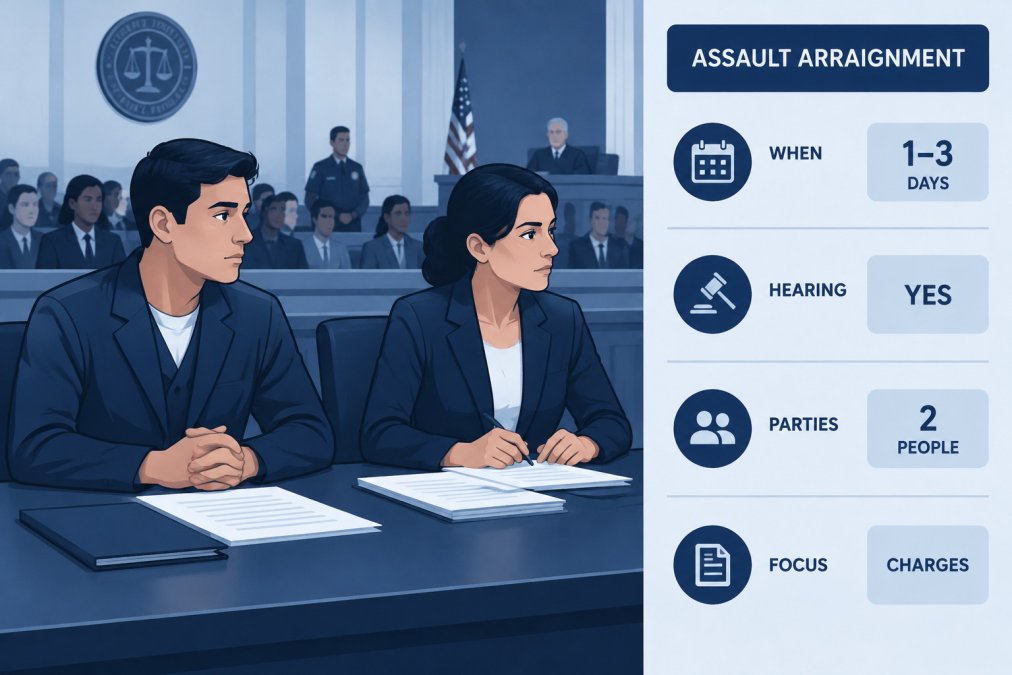
An arraignment is typically held in criminal court after a complaint or charging document has been filed by the prosecutor. The judge confirms the defendant’s identity, reads or summarizes the formal charges, and explains the rights that apply. The California Courts Self-Help Guide describes the arraignment as the point where a defendant learns the charges and rights, and where a judge can appoint a lawyer if the defendant cannot afford one California Courts Self-Help Guide on arraignment.
Key things to know at this stage:
- Timing: The arraignment usually comes soon after arrest or after charges are filed.
- Purpose: It is mainly about charges, plea, and release conditions, not a full trial.
- Who is there: The judge, the prosecutor, the defendant, and usually a defense attorney or public defender.
How the Defendant Is Told the Charges
At arraignment, the judge or the court clerk informs the defendant of each charge in the complaint. The defendant may waive a full reading if the defense attorney has already reviewed the document. The defendant does not have to say anything about the facts at this stage.
What the defendant should listen for:
- The specific offense named, such as assault or assault with a deadly weapon
- Whether the charge is a misdemeanor or a felony
- Any enhancements or related counts listed in the complaint
- The maximum possible penalties as stated by the court
Hearing the exact wording matters. Small differences in the charge can change the case significantly.
What Happens at an Arraignment for a Misdemeanor Assault
A misdemeanor assault arraignment in Los Angeles County is usually the shortest criminal court appearance a defendant will have, but it is not a formality. The court confirms identity, addresses the complaint, takes a plea, and decides release, often in a matter of minutes. Because simple assault is typically charged as a misdemeanor, the practical stakes at this hearing center on custody status, protective conditions, and the next date rather than on prison exposure.
What the court actually does, step by step:
- Calling the case. The judge or clerk confirms the defendant’s legal name and date of birth against the complaint. A mismatch in spelling or a missing middle name can delay the calendar, so bring identification.
- Addressing the complaint. The court asks whether the defendant wants the complaint read in full. Most defense attorneys waive the reading after reviewing the charging document, but the waiver should be a decision, not a default.
- Taking the plea. The defendant enters not guilty, guilty, or no contest. A not-guilty plea at this stage preserves every option and is the most common choice; a guilty or no-contest plea at arraignment can lock in consequences before discovery is reviewed.
- Setting release terms. For a misdemeanor, the judge may release the defendant on a promise to appear, set a bail amount, or impose conditions. California law requires courts to consider specified factors before releasing some people charged with certain domestic-violence-related offenses.
- Issuing protective orders. If the alleged victim is a spouse, cohabitant, or dating partner, the judge may issue a criminal protective order at arraignment. The order can require the defendant to stay away from the person, their home, and their workplace. Read the order carefully and follow it exactly.
- Scheduling the next date. The court sets a pretrial hearing, usually several weeks out, and notes it on the minute order.
Watch out: A misdemeanor arraignment can turn into a custody hearing if the judge believes the defendant is a flight risk or a safety concern, so do not assume release is automatic.
Preparation matters more than people expect. Before the date, confirm the courthouse and department on the court’s website or by calling the clerk, arrive early enough to clear security screening, and bring a photo ID, the citation or charging paperwork, and your attorney’s contact information. Many Los Angeles County courthouses allow remote appearance for some misdemeanor calendars, but the rules vary by department, confirm with the clerk rather than assuming.
Here is what the court typically does at a misdemeanor assault arraignment, step by step.
| Step | What happens | Key note |
|---|---|---|
| Calling the case | Judge or clerk confirms legal name and date of birth | Bring identification to avoid delay |
| Addressing the complaint | Court asks whether to read the complaint in full | Defense usually waives the reading |
| Taking the plea | Defendant enters not guilty, guilty, or no contest | Not guilty is the most common choice |
| Setting release terms | Judge sets release, bail, or conditions | Release is not automatic |
| Issuing protective orders | Criminal protective order may issue | Follow the order exactly |
| Scheduling the next date | Court sets a pretrial hearing | Usually several weeks out |
What Happens at an Arraignment for a Felony Assault
A felony assault arraignment carries more procedural weight than a misdemeanor one, and the difference is not just the label on the complaint. To understand how these offenses differ under state law, see Aggravated vs Simple Assault in California.
What typically happens, in order:
- Formal reading and waiver. The court confirms that the defendant understands each felony count. Defense counsel often waives a full reading after reviewing the complaint, but the defendant should still confirm the exact charge and any enhancements before any plea is entered.
- Counsel determination. If the defendant cannot afford a lawyer, the court appoints a public defender or, in some cases, a panel attorney. Felony cases move faster when counsel is in place at arraignment, because bail and preliminary hearing dates are often argued the same day.
- Bail and release argument. Felony bail is frequently contested. The judge weighs the seriousness of the alleged injury, the defendant’s prior record, ties to the community, and public safety. Courts must consider specified factors before releasing some people charged with certain serious or violent felonies, and the prosecutor may argue for no bail at all. Release may also come with conditions such as electronic monitoring or a stay-away order.
- Protective orders. A criminal protective order can issue at arraignment and may remain in effect through the case. The scope can include the alleged victim’s residence, workplace, and vehicle. Understand the exact terms before leaving the courtroom.
- Preliminary hearing setting. For a felony, the court sets a preliminary hearing, generally within a set statutory window after arraignment unless the defense waives time. At that hearing, a judge decides whether enough evidence exists to hold the case for trial. The arraignment itself does not decide guilt, it decides the path.
Watch out: A felony arraignment can result in custody if bail is set at an amount the defendant cannot post, and the preliminary hearing date can arrive quickly, so lining up counsel and a bail plan before the appearance matters.
Practical preparation for a felony date is similar to a misdemeanor but with higher stakes. Confirm the courthouse and department in advance, allow time for security screening, and bring photo identification, the charging paperwork, and your attorney’s contact details. If you are in custody, ask counsel what to expect at the preliminary hearing and which documents, police reports, witness names, video evidence, should be gathered before then.
Because the stakes are higher, early legal guidance matters more in felony cases.
Entering a Plea, Counsel, and Bail or Release Conditions
The defendant typically enters one of three pleas: not guilty, guilty, or no contest. Most people plead not guilty at arraignment so the case can be reviewed properly before any decision is made. Pleading guilty or no contest at this stage can have lasting consequences, so it should not be done without careful advice.
The right to an attorney is important here. If the defendant cannot afford a lawyer, the court can appoint a public defender. Bail or release conditions may be set at this hearing, and some people may be released on their own promise to return. Others may need to post bail. Readers wondering how to reduce bail can review options such as how to get bail reduced in Los Angeles, and can compare release options through cash bail vs personal recognizance for misdemeanors.
Can You Go to Jail at an Assault Arraignment?
It is possible to be taken into custody at or after an arraignment, especially if bail is not posted or if the judge sets conditions the defendant cannot meet. Some defendants are released the same day, while others remain in custody until bail is posted or a later hearing is held.
Whether a person is held or released depends on:
- The seriousness of the charge
- The defendant’s prior record
- Concerns about safety or flight risk
- Any protective orders in place
Do not assume you will be released automatically. Being prepared with information about the case helps.
What Happens After an Assault Arraignment
After arraignment, the case moves to the next stage. This may include a preliminary hearing for felonies, pretrial conferences, discovery, and negotiations with the prosecutor. The court will list the next date on the paperwork.
Important next steps:
- Keep every court date. Missing one can lead to a warrant.
- Follow all release conditions, including no-contact orders.
- Gather documents and names of witnesses for your attorney.
- Avoid discussing the case on social media or with the alleged victim.
Booking Your Free Case Evaluation Before Your Next Court Date
Your next court date may come quickly, and the decisions made early can shape the rest of the case. Book a free case evaluation with an assault defense lawyer to review the charges, release conditions, and your options before you appear in court.
Frequently Asked Questions
Can an assault case be dismissed at an arraignment?
Yes, it can, though it is not common. At arraignment, the prosecutor may decline to file certain charges, or the court may dismiss a case if the evidence is insufficient or the charges were filed in error. Dismissal usually depends on the prosecutor’s review of the police report and any available evidence. A defense attorney can request a review of the charges and raise issues early, which is one reason to have counsel present from the first appearance.
Does the alleged victim have to appear at an assault arraignment?
Generally, the alleged victim is not required to attend the arraignment. The case is brought by the prosecutor on behalf of the People of the State of California, so the victim is typically a witness rather than a party. A victim may still receive notice of the hearing and may be able to make their views known through the prosecutor. Whether a victim must attend can depend on the specific case, so confirm details with your attorney or the court.
Does an assault arraignment mean you are going to jail?
No. An arraignment is a first court appearance, not a sentencing hearing. Many people attend arraignment after being released from custody, and some are released at or after the hearing. The judge will address bail or release conditions, which can include a bond, supervised release, or conditions such as no contact with the alleged victim. Whether you remain in custody depends on the charges, your record, and the judge’s decision on release.
What should you bring to an assault arraignment?
Bring a government-issued photo identification, the notice or paperwork you received about your court date, and the case number if you have it. Arrive early to allow time for security screening at the Los Angeles courthouse. Dress appropriately, and bring the names and contact details of any attorney you have spoken with. Contact your attorney before the hearing so they can confirm the details and advise you on what to expect.
