
Table of Contents
- Immediate Steps to Take After Being Accused
- Gathering Physical and Digital Evidence to Disprove Domestic Violence Claims
- Understanding California Penal Code 273.5 Defense Strategies
- The Role of Legal Representation in Proving Innocence
- How to Handle a Domestic Violence Restraining Order
- Protecting Your Mental Health and Digital Footprint During a Case
- Understanding Burden of Proof in Civil vs. Criminal Cases
- Frequently Asked Questions
Last Updated: September 23, 2026
Immediate Steps to Take After Being Accused
Being accused of domestic violence is a serious matter that demands immediate action, as you’ll need to prove innocence domestic violence charges require strategic defense from the start. Your first hours and days set the foundation for your entire defense. Do not minimize what’s happening or assume it will resolve on its own.
The moment you’re accused, stop all contact with the accuser. This includes phone calls, texts, emails, and social media. Any communication can be twisted and used against you in court. Silence is your strongest tool right now.
Document everything that happened. Write down the date, time, location, and details of the incident while your memory is fresh. Include names of witnesses who can support your account. Store this information securely, on your phone, in a cloud service, or with a trusted person.
Gather physical evidence immediately:
- Photos of your injuries or lack thereof
- Clothing from that day
- Medical records if you sought treatment
- Security camera footage from your home or nearby
- Phone records showing communication patterns
Do not delete anything. Prosecutors will search for deleted messages, and destruction of evidence makes you look guilty. Keep everything exactly as it is.
Contact a criminal defense attorney within 24 hours. This is non-negotiable. An experienced attorney protects your rights during police questioning and prevents you from saying things that damage your case. At Naderi Law Office, Inc., we know exactly what police will ask and how to shield you from traps.
Gathering Physical and Digital Evidence to Disprove Domestic Violence Claims
Evidence to disprove domestic violence claims requires both physical and digital documentation. The stronger your evidence collection, the harder it becomes for prosecutors to prove their case beyond a reasonable doubt.
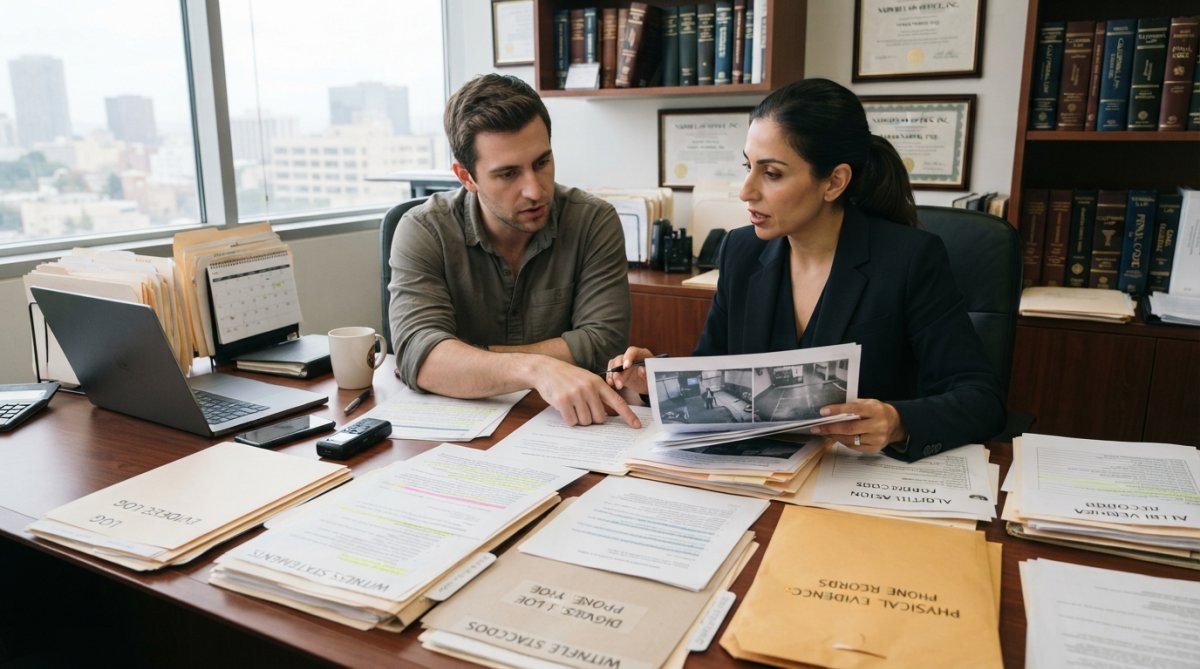
Physical evidence matters most in court and is essential to prove innocence domestic violence allegations. Photographs of your body showing no injuries are powerful. If the accuser claims you hit them, photos showing no bruises, marks, or swelling undermine their credibility. Take photos from multiple angles in natural light. Include the date and time stamp.
Medical records are critical. If you were examined after the alleged incident, those records either support or contradict the accuser’s claims. Request all medical documentation from any hospital or clinic visit. Injuries fade quickly, medical records create a permanent timeline.
Witness statements carry significant weight. Anyone present during the alleged incident can testify about what actually happened. Get written statements from witnesses as soon as possible, including their full names and contact information. Their accounts may directly contradict the accuser’s story.
Digital evidence is increasingly important in domestic violence cases:
- Text message logs showing the tone and nature of your relationship
- Email exchanges that reveal the accuser’s state of mind
- Social media posts from the accuser contradicting their claims
- Call logs showing communication patterns
- Location data from your phone proving you were elsewhere
Preserve all digital evidence now. Screenshots alone aren’t enough, download complete conversations, including metadata. Your attorney can request official records from phone carriers and social media platforms, but having your own copies prevents claims that evidence was lost or altered.
Video footage is the gold standard. Home security cameras, doorbell cameras, or nearby business surveillance can establish your location and what actually occurred. Check with neighbors, local businesses, and parking lots for additional camera coverage.
Understanding California Penal Code 273.5 Defense Strategies
California Penal Code Section 273.5 defines domestic violence as willfully inflicting injury on an intimate partner or former partner. Understanding this statute is essential to building your defense against false accusations.
The prosecution must prove several elements beyond reasonable doubt:
- You willfully committed the act
- The act caused visible bodily injury
- You knew the victim was your intimate partner
- The injury was not an accident
Each element must be proven. If even one fails, the case should be dismissed. A skilled defense attorney attacks each element systematically.
“Willfully” means you acted deliberately, not accidentally. If the accuser fell, pushed you first, or the injury happened during lawful self-defense, the willfulness element collapses. This is where your evidence matters, witness testimony about who initiated contact, photos showing defensive injuries on your body, or security footage can prove the act wasn’t willful.
Visible bodily injury is required. Redness that fades in hours, minor scratches, or claimed pain without visible marks don’t meet this standard. Medical records showing no injuries are devastating to the prosecution’s case. If the accuser has no documented injuries, reasonable doubt exists.
The burden of proof rests entirely with prosecutors. They must convince a judge or jury beyond a reasonable doubt. This is a high bar. Contradictory evidence, credibility problems with the accuser, and lack of physical evidence all contribute to reasonable doubt.
Common defense strategies include:
- Self-defense (you acted to protect yourself from harm)
- Accident (the injury wasn’t intentional)
- False accusation (the accuser is lying for custody, revenge, or other motives)
- Mistaken identity (you weren’t the person involved)
- Lack of injury (no visible bodily injury occurred)
The Role of Legal Representation in Proving Innocence
Your attorney is your shield during the entire process. Without skilled legal representation, you face prosecutors, police investigators, and judges alone. The stakes are too high for that risk.
An experienced criminal defense attorney understands the system. They know what evidence prosecutors need to win, what weaknesses exist in their case, and how to exploit those weaknesses. They’ve handled hundreds of cases and recognize patterns that judges and juries don’t see.
Your attorney protects you during police interrogation. Police are trained to extract confessions. They use psychological tactics, minimize the seriousness of charges, and suggest leniency if you cooperate. Without your attorney present, statements you make can destroy your defense. Your attorney ensures you don’t answer questions without understanding the consequences.
Legal representation means discovery, the process where prosecutors must share evidence with your defense team. Your attorney reviews police reports, witness statements, and physical evidence. Often, exculpatory evidence exists that proves your innocence. Prosecutors sometimes overlook it or bury it. Your attorney finds it and uses it.
At Naderi Law Office, Inc., our attorneys are available 24/7 because we know these situations don’t wait for business hours. We provide personalized legal strategies tailored to your specific case. We’ve helped individuals navigate false accusations and protect their futures. Your first consultation is free, use it to understand your options and build your defense.
Your attorney also handles restraining orders, which often accompany domestic violence accusations. These orders can devastate your life, preventing contact with your children or forcing you from your home. Your attorney fights these orders and protects your rights.
How to Handle a Domestic Violence Restraining Order
A domestic violence restraining order is a court order that restricts your contact with the accuser. Violating it results in immediate arrest and additional criminal charges. Understanding how to handle this order is critical.
Restraining orders come in two types.
Protecting Your Mental Health and Digital Footprint During a Case
False accusations create psychological trauma. You’re facing potential prison time, loss of custody, job loss, and permanent damage to your reputation. The stress is real and severe. Protecting your mental health isn’t weakness, it’s essential to surviving this process.
Understanding Burden of Proof in Civil vs. Criminal Cases
The burden of proof differs dramatically between criminal and civil cases. Understanding this distinction is essential to your defense strategy.
Frequently Asked Questions
What should I do immediately after being accused of domestic violence?
First, do not contact the accuser or anyone connected to them. Exercise your right to remain silent and request a criminal defense attorney before answering police questions. Preserve all evidence, including text messages, emails, and timestamps of your location. Document the false accusation in writing with dates and details. Avoid posting on social media about the case. Contact a qualified criminal defense attorney immediately, they can advise you on next steps, help you understand the charges, and protect your legal rights during police interrogations and court proceedings.
How can digital evidence help prove innocence in false domestic violence accusations?
Digital evidence to disprove domestic violence claims includes text message logs, emails, social media messages, GPS location data, and surveillance footage that establish your whereabouts or demonstrate the accuser’s credibility issues. Phone records showing communication patterns, timestamped photos or videos, and calendar entries can corroborate your account of events. Digital evidence also includes metadata from devices and communications that prove when and where interactions occurred. Your attorney can file discovery motions to obtain the accuser’s digital communications, which may reveal fabricated claims or inconsistencies. Preserve all your own digital records immediately, do not delete anything, as this could harm your defense.
What is the burden of proof in a domestic violence case, and how does it differ between criminal and civil proceedings?
In a criminal domestic violence case, the prosecution must prove guilt beyond a reasonable doubt, which is a very high standard requiring the jury to be convinced of your guilt to a near certainty. In a civil restraining order proceeding, the burden of proof is lower: the accuser must prove their case by a preponderance of the evidence, meaning it is more likely than not that the allegations are true. Understanding this difference is critical because it affects how your defense strategy is built. Your criminal defense attorney will challenge the prosecution’s evidence and highlight reasonable doubt, while in civil proceedings, even small inconsistencies in the accuser’s testimony can shift the balance in your favor.
How do I handle a domestic violence restraining order while defending against false accusations?
If a domestic violence restraining order or no-contact order has been issued, comply with it strictly, any violation can result in additional criminal charges. Your attorney can file a motion to modify or lift the order if it was issued without proper due process or if the evidence does not support it. Document any violations by the accuser, as this demonstrates their credibility issues and may support your defense. Request a hearing to contest the protective order, where you can present evidence and cross-examine the accuser. Do not attempt to contact them directly or communicate through third parties, as this will violate the order and damage your case. Your legal counsel will handle all communication and court filings on your behalf.