
Last Updated: November 5, 2026
Quick Summary
To testify in your own defense, you must decide personally, since the Fifth Amendment protects you from being forced to take the stand and no judge or prosecutor can compel you. Prepare with your attorney by reviewing every prior statement, rehearsing cross-examination, and building your direct testimony around the few facts only you can supply.
- Judges instruct juries that a defendant’s silence is not evidence of guilt, and the prosecution cannot comment on it.
- On cross-examination, answer only what is asked and never guess at details you do not remember.
- If you do not remember, say I don’t recall rather than filling the gap with a guess.
- A 2026 U.S. Supreme Court ruling allows courts to bar discussing ongoing testimony with counsel during an overnight recess.
- Naderi Law Office, Inc. offers a free case evaluation and is available 24/7.
Table of Contents
- Your Fifth Amendment Rights in Criminal Trials and the Decision to Testify
- The Risks of Testifying as a Defendant
- Step 1: Build Your Testimony With Your Defense Attorney
- Step 2: Cross-Examination Preparation for Defendants
- Step 3: Answering Difficult Questions and Memory Gaps Truthfully
- Step 4: How to Stay Calm on the Witness Stand
- Common Mistakes That Weaken Defendant Testimony
- Preparing Your Defense With Naderi Law Office
- Frequently Asked Questions
Your Fifth Amendment Rights in Criminal Trials and the Decision to Testify
Learning how to testify in your own defense starts with understanding that the choice to testify in your own defense belongs to you, not your lawyer. The Fifth Amendment to the U.S. Constitution protects every criminal defendant from being compelled to testify against themselves. At Naderi Law Office, Inc., we walk clients through this decision because it shapes the entire trial.
The stakes are real. The Advisory Committee on Evidence Rules agenda book noted in May 2026 that defendants often stay silent, betting that silence hurts less than testifying. Sometimes that bet pays off. Sometimes it does not.
Below, we break down the rights, the risks, and the preparation steps that matter.
You Cannot Be Forced to Take the Stand
No judge can order you to testify. No prosecutor can call you as their witness. The right to testify is personal, and so is the right to remain silent.
Your defense attorney can advise you. But the final call is yours alone.
What the Jury Is Told About Your Silence
Judges instruct juries that a defendant’s silence is not evidence of guilt. The prosecution cannot comment on it. This instruction is one reason many defendants stay off the stand.
But jurors are human. They notice who speaks and who does not. That tension sits at the heart of every decision to testify.
The Risks of Testifying as a Defendant
The biggest risk is cross-examination. Once you take the oath, the prosecutor gets to question you, and those questions are built to damage your credibility.
Cross-Examination and Prior Statements
Prosecutors compare your testimony to everything you have said before: police interviews, written statements, even social media posts. Any gap becomes a tool for impeachment.
A common mistake is assuming you can explain away an old statement on the spot. In practice, contradictions stick with the jury.
When the Benefits Outweigh the Risk
Testifying can help when intent is central to the case or you are the only person who can explain what happened. A Georgia defense-law analysis from Prine Law makes this point for cases where the defendant’s own account is the defense.
Our view: testify when your story is consistent, documented, and strong under pressure. Stay silent when it is not.
Step 1: Build Your Testimony With Your Defense Attorney
Preparation starts long before trial. Your attorney reviews the evidence with you, including police reports and witness statements. You will walk through direct examination, meaning the questions your own lawyer asks first, and you will rehearse hard cross-examination questions.
A useful way to think about the process is as a sequence of courtroom events. On direct examination, your attorney asks open questions and you give fuller answers. On cross-examination, the prosecutor asks leading questions that suggest their own answer, and your job narrows to answering exactly what is asked. On redirect, your attorney may return to repair damage from cross. Knowing this order in advance keeps you from treating every question the same way.
Work through these preparation steps with counsel:
- Read the charging document and the police reports together, line by line, so you know what the government claims before you say a word.
- Identify the two or three facts only you can supply, and build your direct testimony around those facts rather than around the whole story.
- Decide with counsel whether your direct examination will be narrative, where you tell the account in your own words, or question-and-answer, where counsel controls the pace. Each format has trade-offs: narrative sounds natural but can wander, while question-and-answer keeps you tight but can sound coached.
- Rehearse the transition from direct to cross, because the first hostile question often comes immediately after your attorney says, “No further questions.”
- Review the rules the judge will read to the jury, including the instruction that your silence cannot be treated as evidence of guilt, so you understand what the jury has already been told.
- Confirm courtroom logistics: where you will sit, whether you will stand, how exhibits are marked, and how you will be handed documents to identify.
If your case is heading toward an earlier court date, our guide on how to prepare for a preliminary hearing covers that stage step by step.
Watch out: treating preparation as memorizing a script backfires, because a rehearsed answer that does not match the question reads as evasive to jurors and gives the prosecutor an opening.
Step 2: Cross-Examination Preparation for Defendants
Cross-examination preparation for defendants comes down to one rule: answer only what is asked. Do not volunteer details, and do not guess.
Work through these drills with counsel:
- Practice short answers: yes, no, and one sentence when needed
- Review every prior statement line by line
- Identify the three questions you fear most, then answer them aloud until calm
- Learn when your attorney will object, and let them do it
The Criminal Attorney Polk analysis warns that cross-examination creates real danger. Rehearsal is how you manage it.
Step 3: Answering Difficult Questions and Memory Gaps Truthfully
Honesty is your strongest tool on the stand. If you do not remember, say so plainly: “I don’t recall.” That answer is allowed, and juries accept it far better than a guess that collapses later. The harder skill is telling the difference between a true memory gap and a contradiction the prosecutor is trying to build.
Use these answer patterns, and practice them aloud until they feel natural:
- For a genuine gap: “I don’t remember that detail.” Do not add a guess to fill the silence.
- For a partial memory: “I remember the conversation, but not the exact words.” This is more credible than claiming precision you do not have.
- For a document you are shown: read it before answering, then say what it does or does not refresh. If it helps you remember, say so; if it does not, say that too.
- For a question you do not understand: “Could you repeat that?” or “I don’t understand the question.” Asking is not weakness.
- For a question that assumes something untrue: “That’s not what happened.” Correct the premise briefly, then stop.
- For a question calling for an opinion you do not have: “I don’t know.” That is a complete answer.
Handle hard questions this way:
- Pause before answering. A short silence is not weakness.
- Answer the exact question, then stop.
- Never argue with the prosecutor. Your attorney handles objections.
- If a prior statement is read to you, listen to the whole excerpt before responding, because the prosecutor may be counting on you to interrupt.
Watch out: guessing to fill a memory gap is the fastest way to lose credibility, because one wrong detail can undercut everything else you said, and the prosecutor will return to that detail on redirect and in closing argument.
Step 4: How to Stay Calm on the Witness Stand
Staying calm on the stand begins with breathing and posture. Slow your breath before you answer. Keep your hands still. Look at the questioner, not the floor.
Practical habits that help:
- Arrive early and sit through the courtroom routine
- Wear clothing that feels comfortable and respectful
- Drink water during breaks, not during testimony
- Focus on the truth of your answer, not the jury’s reaction
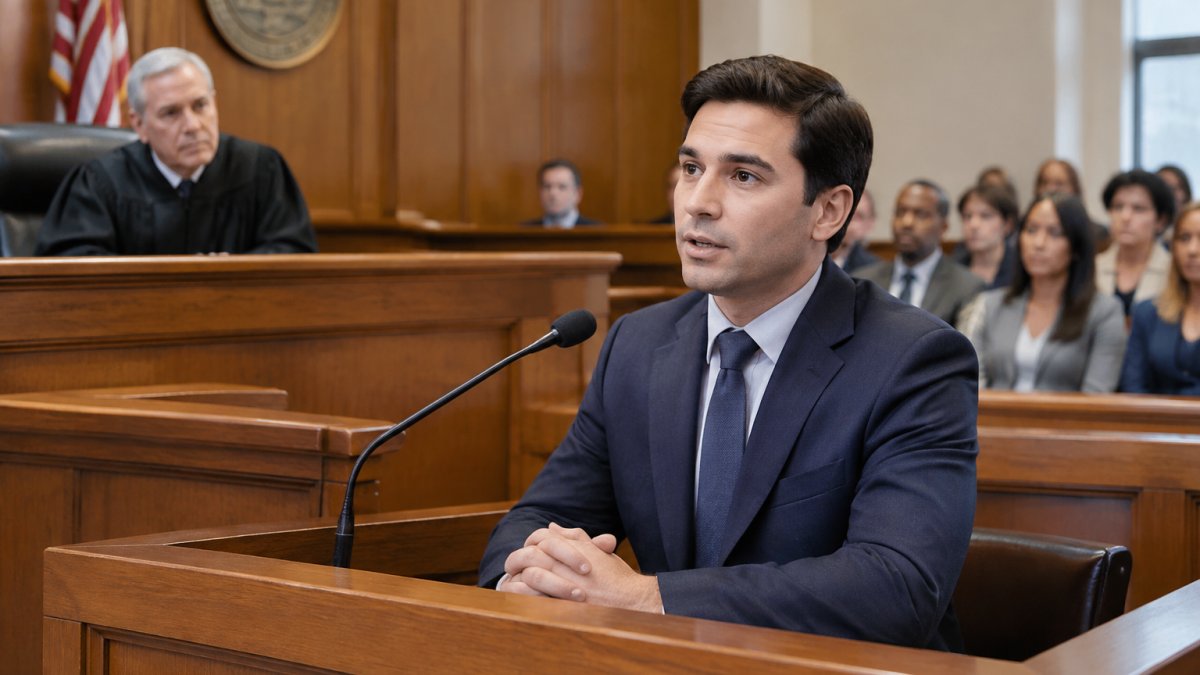
A 2026 U.S. Supreme Court ruling covered by SCOTUSblog allows courts to bar defendants from discussing ongoing testimony with counsel during an overnight recess. Plan your answers knowing you may not get a mid-testimony consultation.
Common Mistakes That Weaken Defendant Testimony
The same errors show up again and again. Avoid these:
- Over-explaining to seem credible
- Losing temper under pressure
- Contradicting a prior statement without a clear explanation
- Dressing or acting in a way that distracts the jury
- Treating the prosecutor as an opponent to defeat instead of a questioner to answer
| Mistake | Why It Hurts | Fix |
|---|---|---|
| Guessing at details | Undermines all your testimony | Say “I don’t recall” |
| Long answers | Opens new lines of attack | Answer, then stop |
| Arguing with the prosecutor | Looks defensive to jurors | Let counsel object |
| Ignoring prior statements | Invites impeachment | Review them with counsel |
Preparing Your Defense With Naderi Law Office
Deciding whether to testify is one of the most consequential choices in a criminal case. It deserves careful preparation, honest advice, and an attorney who knows the courtroom.
At Naderi Law Office, Inc., our seasoned attorneys build defense strategies around the facts of your case. We offer a free case evaluation and are available 24/7. Before you commit to counsel for something this serious, read our 5 questions to ask before choosing a criminal defense lawyer, and learn more about working with an experienced defense attorney. If you are still early in the process, our step-by-step guide covers what to do after an arrest.
Frequently Asked Questions
Is a defendant legally required to testify in their own defense?
No. Under the Fifth Amendment, a criminal defendant cannot be compelled to testify, and the decision belongs to the defendant personally, not to the judge or the attorney. Defense counsel can advise, but the client makes the final call. If you choose not to take the stand, the judge instructs the jury that your silence cannot be held against you, and the prosecution still carries the full burden of proving guilt beyond a reasonable doubt. Many defendants decline to testify on the reasoning that their silence is less damaging than cross-examination.
What are the risks of testifying in a criminal trial?
The biggest risk is cross-examination. Once you take the oath and testify on direct examination, the prosecutor can question you about inconsistencies, prior statements, and in some circumstances prior convictions, all of which the jury weighs against your credibility. A single contradictory answer can undercut an otherwise strong defense. Testifying also opens the door to lines of questioning that would not exist if you remained silent. Many defendants frequently choose not to take the stand for exactly this reason.
How can I prepare to testify effectively if I choose to take the stand?
Preparation starts well before trial. Review the evidence, your prior statements, and the timeline of events with your defense attorney, then practice direct examination and cross-examination preparation for defendants, including the questions you least want to answer. Learn to say you do not recall when you genuinely do not, and to correct a wrong answer immediately rather than letting it stand. Courtroom demeanor matters too: slow down, breathe, and address the jury in plain language. Courts may limit attorney-client discussion during overnight recesses while testimony is ongoing, so plan your strategy in advance.
Can a judge or jury hold it against me if I choose not to testify?
They are not supposed to. The judge gives a jury instruction stating that the defendant’s decision not to testify is not evidence of guilt and cannot be considered in reaching a verdict. The prosecution also cannot comment on your silence as proof of wrongdoing. That protection is a core part of your Fifth Amendment rights in criminal trials. In practice, jurors are human, which is why the decision to testify or remain silent is a strategy question to work through carefully with your defense attorney rather than a decision made in the moment.
The right to testify belongs to you, and so does the decision. Make it with counsel who prepares you for every question. Contact Naderi Law Office, Inc. today for a free case evaluation, and get a defense team that protects your freedom, your record, and your future.
